Social Security Disability FAQ

Do I need a representative?
If you have applied for disability benefits and received a denial, or if you are thinking about applying but are unsure where to begin, representation can help you understand the process and avoid common mistakes. Disability claims are often denied because the evidence does not clearly explain the claimant’s medical conditions, functional limitations, work history, or eligibility. The Disability Claim Center helps claimants review the record, identify issues that may be affecting the claim, and take the next step in the application or appeal process.
How much does it cost?
Disability representation is generally handled on a contingency fee basis. This means there is no representative fee unless your claim is successful and past-due benefits are awarded.
For Social Security Disability and SSI claims, representative fees are approved by the Social Security Administration. Under the standard fee agreement process, the fee is limited to 25% of past-due benefits or the maximum amount set by SSA, whichever is less.
For Veterans Disability Compensation claims, fees are generally based on a percentage of past-due benefits awarded. VA regulations presume that fees of 20% or less of past-due benefits are reasonable when the representative continues representation through the decision awarding benefits.
Case expenses, such as fees charged by medical providers for records or reports, are separate from the representative fee and are generally the claimant’s responsibility.
Additional fees and or exspenses?
There may be case-related expenses during the claim or appeal process. These may include costs charged by medical providers for records, medical opinions, copying, postage, or other necessary case expenses. Travel or lodging expenses are uncommon, but may apply in limited situations if they are necessary and agreed to in advance.
Case expenses are separate from any representative fee. When possible, you will be notified of anticipated expenses before they are incurred. In most cases, these expenses are minimal, but they remain the claimant’s responsibility unless otherwise agreed in writing.
Who can apply for adult disability benefits
Adults may apply for Social Security Disability benefits if they are unable to work because of a physical or mental medical condition that has lasted, or is expected to last, at least 12 months or result in death.
For Social Security Disability Insurance, also called SSDI, eligibility generally depends on whether you have worked long enough and recently enough to be insured under Social Security. Supplemental Security Income, or SSI, is a separate needs-based disability program for individuals with limited income and resources.
If you recently received a denial, you may need to file an appeal rather than a new application. Appeal deadlines are important, so it is best to review the denial notice as soon as possible.
Who can apply for Supplemental Security Income (SSI)
Supplemental Security Income, or SSI, is a needs-based disability program for people with limited income and resources. Adults may qualify for SSI if they are disabled, blind, or age 65 or older and meet Social Security’s financial eligibility rules.
For adults under age 65, SSI disability eligibility generally requires a physical or mental medical condition that prevents substantial work and has lasted, or is expected to last, at least 12 months or result in death. SSI does not require the same work-credit history as Social Security Disability Insurance, but income and resource limits apply.
Some claimants may qualify for SSI, SSDI, or both. If you are unsure which program applies to your situation, we can help review the issue and discuss the next step.
Can I apply online?
Can I apply online?
Many Social Security Disability and SSI claims can be started online through the Social Security Administration’s website. Before applying, it is helpful to gather information about your medical treatment, medications, work history, education, and any other benefits you receive.
If you recently received a denial notice, you may need to file an appeal instead of starting a new application. Appeal deadlines are important. If you are unsure whether you should apply, appeal, or request review of a prior decision, contact us before taking the next step.
MORE Social security disability FAQ
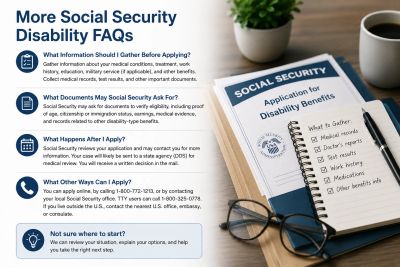
What Information Should I Gather Before Applying?
Before applying for Social Security Disability or SSI, it is helpful to gather information about your medical conditions, treatment providers, medications, work history, education, military service if applicable, and any other benefits you receive.
You should also collect medical records, test results, doctors’ reports, proof of age or citizenship if requested, W-2s or tax information, and documents related to workers’ compensation or other disability-type benefits.
Do not delay filing only because you do not have every document. However, the more complete your information is, the easier it is to identify what evidence may be missing and what issues could affect the claim.
What information and documentation do I need to apply?
Social Security may ask for documents to verify eligibility, including proof of age, citizenship or lawful immigration status, military service if applicable, earnings, workers’ compensation or other disability-type benefits, and medical evidence already in your possession.
Medical evidence may include treatment records, test results, hospital records, imaging reports, medication lists, and written statements or reports from medical providers. You do not need to have every document before starting a claim, but complete and accurate information can help avoid delays.
Do not send original documents to anyone unless you understand where they are going and whether originals are required. Social Security may accept copies of many records, but some identity or eligibility documents may require originals or certified copies.
What happens after I apply?
After you apply, Social Security reviews the application and may contact you for additional information or documents. In most disability claims, the medical portion of the case is sent to a state Disability Determination Services office, often called DDS, for review.
DDS may request medical records, send forms for you to complete, contact your medical providers, or schedule a consultative examination if more information is needed. After review, Social Security will mail a written decision.
If your claim is denied, read the notice carefully. The denial letter explains appeal rights and deadlines. In most cases, you have a limited time to appeal, and filing a new application is not always the best next step.
What other ways can I apply?
If you cannot complete the application online, you may apply by calling Social Security at 1-800-772-1213. Social Security representatives are generally available Monday through Friday, 8:00 a.m. to 7:00 p.m. local time. If you are deaf or hard of hearing and use TTY equipment, you may call 1-800-325-0778.
You may also contact your local Social Security office for assistance. SSA recommends calling first because many issues can be handled by phone, and an appointment may be needed for in-person service.
If you live outside the United States or one of its territories, contact the nearest U.S. Social Security office, U.S. Embassy, or consulate.
- By phone - Call us at 1-800-772-1213 from 7 a.m. to 7 p.m. Monday through Friday. If you are deaf or hard of hearing, you can call us at TTY 1-800-325-0778.
- In person - Visit your local Social Security office. (Call first to make an appointment.)
If you do not live in the U.S. or one of its territories you can also contact the nearest U.S. Social Security office, U.S. Embassy or consulate.